
A compassionate path through religious trauma
The Diabolical Trinity
Healing Religious Trauma from a Wrathful God, Tormenting Hell, and a Sinful Self
You may no longer believe what you were taught about God, Hell, or yourself, but still struggle with fear and shame. This book can help you understand why and begin working through it.
Understanding · Compassion · Possibility
Naming the diabolical trinity
Three interrelated beliefs that can cause religious trauma
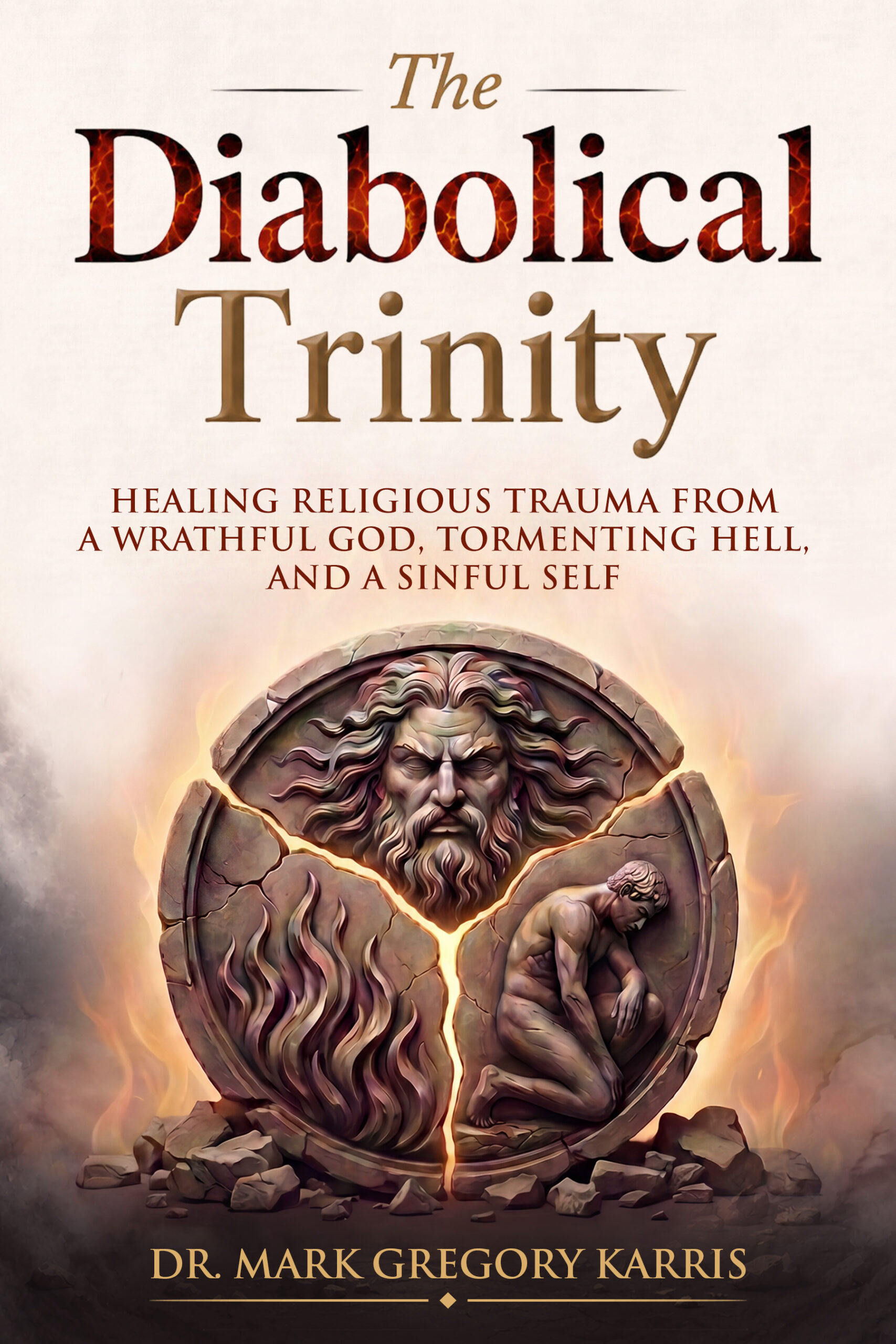
A punishing image of God. The terror of eternal torment. The conviction that something is wrong with you at your core. This book examines how these ideas can become intertwined—and how their hold can begin to loosen.

A Wrathful God
Afraid of the God you’re supposed to trust.
Explore how being taught that God is angry and ready to punish can lead to religious trauma, leaving you struggling to feel safe or loved.

A Tormenting Hell
Your beliefs have changed. The fear hasn’t caught up.
Understand why the fear of eternal torment can linger long after you question what you were taught—and what can help you loosen its grip on your mind and body.
A Sinful Self
Taught you were bad. Still struggling to feel good enough.
Unpack how being told you’re sinful at your core can fuel fear, shame, and a relentless inner critic—and begin learning to treat yourself with compassion.
When religious fear doesn’t go away
Changing your beliefs doesn’t always make the fear go away.
Perhaps you no longer believe in a punishing God, yet still feel afraid. Perhaps shame arrives before you can name it. Perhaps leaving a community brought relief and a loss of belonging.
Karris writes about the lingering echoes of harmful beliefs—what he calls phantom theology—with the understanding of someone who has lived through them.
The book brings personal experience into conversation with psychology, philosophy, sociology, and therapeutic practice.
For the questions you carryWhy am I still afraid of something I no longer believe?
For the shame you inheritedCan I learn to heal from religious trauma and meet myself with kindness?
For the life aheadWhat would it mean to live from my values, rather than my fear?
Inside the book · Three parts, seventeen chapters
Understanding religious trauma and finding ways to heal
A journey through the impact of religious fear, the beliefs that sustain it, and practical ways of responding with care.
Part I · 7 chapters
Understand the impact
Name the anxiety, shame, betrayal, rejection, and bodily experiences that religious trauma can bring.
Explore the 7 chapters
Mapping the Psychological Terrain of Hell Trauma
- What Is Trauma?
- Religious Trauma, Adverse Religious Experiences, and Disorientation
- Hell Anxiety
- Shame and Self-Criticism
- “I Feel Betrayed.”
- Communal Rejection
- Religious Trauma’s Effects on the Body
Part II · 4 chapters
Loosen the old story
Explore the human origins and social functions of hell narratives through psychology, philosophy, and sociology.
Explore the 4 chapters
Wiggling Hell Beliefs From Our Minds
- Conceived in Curiosity, Birthed in Creative Imagination
- Hell as Projections
- Communal Glue, Toxic Pride, and Oppressive Power
- Our Compassion, Goodness, and Wise Discipline Meter Is Not Out of Whack
Part III · 6 chapters
Practice a way forward
Move from understanding into practices that invite self-compassion, inner support, and a life shaped by your chosen values.
Explore the 6 chapters
Unhinging Hell from Our Nervous Systems
- Healing Religious Trauma with Memory Reconsolidation
- “Avengers Assemble!”: Installing Positive Internal Resources
- Self-Compassion: Shame and Self-Criticism’s Kryptonite
- Taming the Inner Critic
- Working through Parent Wounds
- Live Your Values, Despite Your Hellish Symptoms
Understanding becomes practice
Learning to be less afraid and less hard on yourself
Alongside its exploration of beliefs, the book offers reflections and therapeutic practices for the emotional work of healing.
Understand emotional learning
Explore memory reconsolidation and the ways old emotional learnings may be revisited.
Build inner support
Discover practices for imagining and strengthening sources of steadiness, protection, and care.
Meet shame with compassion
Practice a kinder relationship with yourself, including the parts that feel frightened or unworthy.
Respond to the inner critic
Notice harsh internal messages and explore ways to relate to them with greater perspective.
Attend to old wounds
Make space for the parent wounds and relational hurts that may be part of your story.
Live what matters to you
Identify your chosen values and take meaningful steps toward them, even when fear is present.
Your story is yours—and no one else gets to write it for you.
Praise for The Diabolical Trinity
What others are saying about the book
Reflections from scholars, clinicians, authors, and advocates who have engaged with the book.
In The Diabolical Trinity, Mark Karris offers insight and care that is grounded in multiple disciplinary perspectives (psychology, religion, theology, pastoral care). The care that Karris offers readers will be essential reading for religious trauma survivors, particularly those who have been taught to think of themselves and others in terms of punishment or damnation. Karris breaks open the punitive thought systems of hell and saves us from their psychic violence.

In this book, Dr. Karris astutely shows how religion can be perverted into a neurosis through the ideology of hell. Further, he shows how the preaching of eternal damnation causes massive psychological suffering rather than salvation. The book concludes with wise and compassionate strategies to help seekers after God return to their authentic selves after having lived in hell, a living hell caused by this ideology.

Dr. Mark Karris, with his combined experience as an ex-pastor, reconstructionist, and mental health clinician, is the perfect person to lead us through better understanding and unraveling the impact of Hell Indoctrination. Mark takes on this very heavy and much needed task with great care in his latest book, The Diabolical Trinity. I will certainly be adding this magnificently written and very current book to the top of my reading list for religious and spiritual abuse survivors.

In this book, Dr. Mark Karris confronts head-on the tricky topic of Hell indoctrination and offers practical ways to move toward healing and recovery. He uses a research-based trauma-informed approach offering hope to those who are haunted by the effects of such teachings. This book is a must-read for anyone who lives in fear of burning in Hell eternally and the professionals who work with them.

Read all 18 additional endorsements
Mark Karris not only explores the deeply violent emotional and spiritual damage done by Hell indoctrination with true insight and compassion, but also offers a real path to recovery.

I'm so glad Mark Karris has written this brilliant book on healing from hell-related religious trauma. If you have an "inner fundamentalist" who constantly torments you with condemnation, this book by a trained therapist (who has experienced religious trauma himself) can help you heal. Highly recommended!

We know hell is bad for those who suffer there eternally. But who knew how bad it is in the present!?! Mark Karris explores in detail the trauma and psychological abuse that belief in hell causes. This book is the go-to psychological resource for rejecting the idea anyone will be forced to endure eternal conscious torment. And the go-to resource for helping us heal from that idea!

The Diabolical Trinity is deeply insightful and immensely helpful. It shows that religious trauma is real and results in both physical and mental symptoms. If you are one of the unfortunate people raised in such an environment, this book provides up to date therapies that will help you on the journey towards healing.

As a child barely six years old, I was indoctrinated to believe that my beloved cousins who were "unsaved" would burn alive forever and ever... and that their blood would be on my hands. That poison-tipped spear lodged deep within my heart, tormented my sensitive spirit, and altered my vison of God and humanity for decades. I need no better reason to read Mark Karris' The Diabolical Trinity. Thank you for this wise and transformational book!

An important and much needed resource! Karris doesn't leave the reader alone on the path of healing, but instead provides a collection of research-based healing practices for religious trauma that will assist both readers and those who walk alongside them in therapeutic settings.

Karris presents a vitally crucial work, drawing from his clinical counseling experience, to provide a pathway of healing and relief for those who have been injured by their religious upbringing.

Karris weaves together psychological research, clinical narrative and first-person accounts convincingly arguing that the theological concept of hell may be taught in ways leading to complex PTSD and loss of faith. While not a theological treatise, this book is psychologically sound and theologically sophisticated. It is also immediately accessible and practical for clinician and client. I can't wait to recommend it!

Karris brings his therapeutic skills to bear in providing numerous practical tools to enable those who have been religiously traumatized by Hell theology/parenting/abuse to find healing. As a clinical tool, this book will be enormously helpful both to those recovering from such religious trauma and those who are caring for them.

Hell trauma is so common, yet so rarely discussed, and Karris does so with such compassion and clarity. This is essential reading for anyone who was part of a faith tradition that used hell to keep followers in the fold, as well as for therapists seeking to gain a deeper understanding of their clients who have gone through this experience.

As a therapist and Anglican bishop, I believe this book is critical and timely. He explains the foundational aspects of religious trauma, particularly due to Hell indoctrination, and then gives us practical tools to build resilience and help ourselves and others heal from this insidious trauma. The Diabolical Trinity is a must-read. I highly recommend!

His thoughtful deconstruction of the concept of hell from a non-religious standpoint offers a fresh take on this problematic topic. Survivors of Hell doctrine who read The Diabolical Trinity will find validation, education, and practical self-help strategies as they begin their journey of healing from religious trauma.

I know all too well the hold that hell-based theology can have on a person. In The Diabolical Trinity, Dr. Karris not only provides explanations for why beliefs about hell can feel so hard to shake, but he also shares practical guidance and powerful tools. I kept saying, "He gets it! He understands what this feels like!" Reading this book filled me with hope knowing I now have a resource to pass along to folks still in the clutches of these beliefs who are looking to escape. I cannot wait to recommend it to friends and clients alike.

Mark Karris is a wounded healer. He knows the damage of toxic religious doctrines of sin, judgment, and hell from the inside. In The Diabolical Trinity, he brings both personal experience and professional expertise to bear in a profound, compassionate, and eminently practical guide to finding hope and healing.

The Diabolical Trinity is the book I have been seeking for 15 years. If you've recognized religious harm in your life but don't know where to go next, this book is a treasure trove of practical tools for rewiring a nervous system that has trauma written into it. Personally, I found this book validating and empowering; as a clinician, I feel better equipped to meet the needs of my religious trauma clients.

Karris provides practical strategies for all who are recovering from religious trauma. The Diabolical Trinity is a well-researched tool to aid an individual's psychological and emotional wellbeing while they reclaim their spiritual autonomy.

The Diabolical Trinity beautifully unpacks Hell indoctrination, helping readers understand its negative impact on their lives. This is a must read for anyone undergoing faith deconstruction and I am excited to recommend it to my clients in the future.

With the wisdom and compassion of a skilled therapist, Karris guides us through a dismantling of this harmful idea and provides a path to inner peace and healing. I now have a book recommendation for my friends who are still struggling with their fear of Hell!


A Book to Heal
Kick fear in its face.
More room for what matters.
Begin exploring a way beyond the stories that taught you to fear yourself, your questions, and your future.